

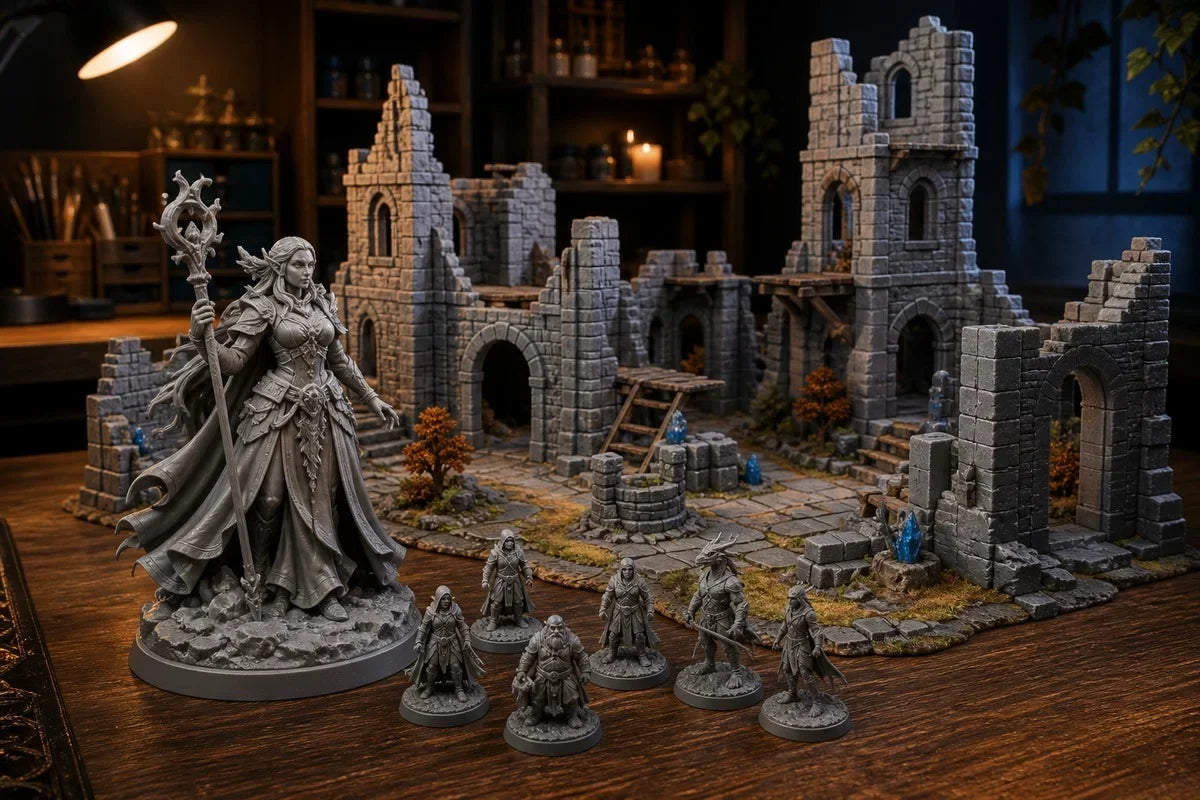
Short answer: choose resin for character miniatures and display pieces where fine detail matters most. Choose FDM for large terrain, vehicles, and props where cost, build volume, and durability matter more. Many tabletop makers get the best results by using both.
The resin vs FDM question sounds simple until you look at what actually goes on a gaming table. A 32mm hero, a dragon, a dungeon wall, and a full ruined tower may all belong to the same campaign, but they place very different demands on a 3D printer.
For small tabletop miniatures, resin printing is usually the quality leader. It captures facial features, armor trim, chainmail, cloth texture, and other details that remain readable after priming and painting. FDM printing is usually more economical for large pieces such as buildings, modular tiles, and Warhammer terrain. The right choice depends less on which technology is “better” and more on what you plan to print.
How Resin and FDM 3D Printing Work
An FDM printer melts filament and lays it down through a nozzle, building the model one line and one layer at a time. It is approachable, materials are widely available, and large parts can be relatively inexpensive. Nozzle diameter and layer height influence how much fine geometry the printer can reproduce.
A Resin 3D Printer cures liquid photopolymer resin in thin layers using controlled light. Because an entire cross-section can be exposed at once, resin printing can reproduce very small features and smooth surfaces without tracing every outline with a nozzle. The tradeoff is a more involved material-handling and cleanup process.
Both technologies build in layers, but their artifacts look different. FDM parts can show horizontal layer lines and stepped curves, especially on rounded armor, faces, and shallow slopes. Resin prints can also show layer artifacts, yet they are typically much finer and less distracting at miniature scale when orientation and settings are appropriate.
Resin vs FDM at a Glance
| Factor | Resin | FDM |
|---|---|---|
| Fine detail | Excellent for faces, textures, and sharp edges | Good for larger features; tiny details may soften |
| Visible layer lines | Usually subtle at miniature scale | More noticeable on curves and shallow angles |
| Large terrain | Possible, but material use and build size can be limiting | Often the more practical and economical option |
| Batching small minis | Efficient when many figures fit on the build plate | Each extra model usually increases print time substantially |
| Post-processing | Wash, dry, support removal, and final cure | Support removal; optional sanding, filling, or smoothing |
| Workspace | Needs a controlled, ventilated cleanup area and PPE | Generally simpler, but ventilation remains sensible |
| Best fit | D&D minis, heroes, monsters, busts, display pieces | Buildings, tiles, vehicles, organizers, large props |
Detail Quality: Why Resin Usually Wins for Miniatures

At 28–32mm scale, a tiny change in surface quality has a large visual effect. A face may only be a few millimeters tall. Belt buckles, teeth, fingers, runes, and chain links are smaller still. Resin’s key advantage is not merely a smoother finish; it is the ability to keep these features separated and readable.
This improved detail quality matters after paint is applied. Recesses need enough depth to accept a wash, and raised edges need enough definition to catch a highlight. If a feature is already soft in the raw print, primer and paint can reduce it further.
Modern small-nozzle FDM printers can produce impressive miniatures, especially with tuned profiles and favorable sculpts. However, printing slowly with a very small nozzle does not remove the fundamental challenge of tracing tiny contours with extruded filament. FDM is most convincing on chunky characters, low-poly styles, larger monsters, and models designed specifically for support-free filament printing.
Layer Lines and Model Orientation
FDM layer lines are easiest to see on domes, faces, cloaks, and other curved surfaces. Lower layer heights can reduce them, but print time increases. Sanding a gaming miniature is difficult because abrasives can flatten the very textures you wanted to preserve.
Resin orientation also matters. Tilting a model can move supports away from the face and presentation surfaces while reducing broad cross-sections. Poor orientation can still cause stepping, support scars, or distorted features, so resin is not automatically flawless. It simply provides a higher ceiling for miniature detail.
D&D Minis, Warhammer Terrain, and Other Use Cases
For D&D Minis: Choose Resin
Player characters, NPCs, monsters, familiars, and bosses usually benefit from resin. These pieces are handled and viewed closely, and their identity comes from small details such as expressions, equipment, clothing, and pose. If your priority is paint-ready D&D minis, a Resin 3D Printer is normally the stronger first choice.
Material selection still matters. A highly detailed but brittle model can lose a sword, staff, horn, or finger during support removal or play. For gaming pieces, look for a resin that balances crisp reproduction with practical toughness, and follow the material maker’s handling and curing guidance.
For Warhammer Terrain: Choose FDM More Often
Walls, ruins, towers, bunkers, movement trays, hills, and modular boards consume far more material than a character miniature. For this kind of Warhammer terrain, FDM often wins on cost, size, and durability. Stone, wood grain, rubble, and industrial textures can also disguise layer lines once primed, dry-brushed, and weathered.
Resin remains useful for terrain details that need crisp edges: doors, statues, control panels, shrines, scatter props, and decorative inserts. A hybrid workflow can therefore be ideal—print the building shell with FDM and use resin for the focal details players will inspect up close.
For Large Monsters and Vehicles: It Depends
Large organic creatures with scales, fur, faces, and intricate armor still benefit from resin if the model can be hollowed, drained, and supported safely. Large vehicles and blocky machines may be easier and less expensive in FDM. Consider whether viewers will notice surface texture, how the model will be transported, and whether the file is already split for a particular process.
Speed, Build Volume, and Batch Printing
FDM print time is closely tied to how much path the nozzle must travel. Adding another miniature usually adds more toolpath and therefore more time. Resin printers expose a layer’s cross-section at once, so placing several minis at the same height on one build plate may add little or no layer exposure time compared with printing one.
That makes resin attractive for squads, enemy groups, or a full encounter of similarly sized models. FDM counters with larger build volumes and practical material costs for tall buildings or wide terrain sections. Compare the actual files you want to print rather than relying only on advertised maximum speed.
Post-Processing: The Biggest Workflow Difference

Post-processing is where the two experiences diverge most. Resin printing requires a controlled workflow for uncured material. Wear suitable gloves, work in a well-ventilated area, follow the resin safety data, wash prints as directed, allow them to dry, remove supports thoughtfully, and complete the recommended final cure. Keep liquid resin and contaminated consumables away from children, pets, and household surfaces.
FDM parts can often be handled when cool. Cleanup may be as simple as removing supports and trimming a brim. For a display-quality terrain piece, you may also sand seams, fill gaps, apply filler primer, or use heat-set inserts. The process can be dusty and time-consuming, but it generally avoids liquid-resin handling.
Support marks matter for both. On resin minis, position contact points on the back, underside, or other low-visibility areas. On FDM terrain, tune overhangs and use model orientations that reduce supports inside windows, arches, and surface textures.
Cost: Look Beyond the Printer Price
The printer is only part of the budget. A useful resin setup may include resin, gloves, wash supplies, a curing solution, replacement film or tank components, filters, and suitable waste handling. FDM typically requires filament, nozzles, build-surface maintenance, and occasional replacement of wear parts. Both benefit from good ventilation, tools, and storage.
Cost per model varies with size, density, hollowing, supports, failures, local material prices, and how you value cleanup time. As a general rule, FDM is economical for large-volume pieces, while resin’s higher workflow overhead buys the fine detail that small premium minis need.
Where the HeyGears RS Turbo Fits
If your collection centers on detailed heroes, monsters, busts, and small-batch character production, a dedicated resin workflow is the logical direction. The HeyGears RS Turbo is a Resin 3D Printer designed for users who value a more integrated printing experience and repeatable miniature results.
For tabletop creators, the practical benefit is consistency: crisp small features, stable surfaces, and a workflow suited to printing several miniatures for a campaign or army. The best results still depend on a well-prepared model, sensible orientation, appropriate supports, compatible material settings, and careful post-processing.
Best fit for RS Turbo
Choose it when your priority is high-detail character miniatures, small monsters, display pieces, or repeatable batches—not when most of your workload is large, low-cost terrain.
Which One Should You Choose?
- Choose resin if most of your projects are 28–32mm characters, detailed monsters, busts, or pieces judged at close range.
- Choose FDM if you mainly want buildings, tiles, organizers, vehicles, large props, or durable low-cost terrain.
- Choose resin first if painting fine faces, armor, fabric, and organic texture is the heart of the hobby for you.
- Choose FDM first if you need the simplest material handling or do not have an appropriate resin workspace.
- Use both if you regularly build complete tables: resin for the focal miniatures and detail inserts, FDM for the environment around them.
For most miniature-focused hobbyists, resin is the more satisfying first machine. For terrain-focused builders, FDM offers better scale and economics. The hybrid approach is not a compromise; it uses each process where it is strongest.
Frequently Asked Questions
Is resin always better than FDM for tabletop miniatures?
No. Resin is usually better for fine character detail, but FDM can be the better choice for large, rugged, or intentionally stylized models. File design and printer tuning also matter.
Can FDM print good D&D minis?
Yes, especially with a small nozzle, low layer height, tuned settings, and models designed for FDM. Expect longer print times and more visible layer lines than a comparable resin print.
Is resin good for Warhammer terrain?
It is excellent for small detailed terrain pieces, statues, doors, control panels, and decorative inserts. FDM is usually more economical for full buildings, walls, and large modular boards.
Which technology is easier for a beginner?
FDM usually has simpler material handling. Resin can deliver better miniature results sooner, but only if you can establish a safe wash-and-cure workflow from day one.
Final Verdict
In the resin vs FDM decision, match the printer to the object. Resin leads in miniature-scale detail quality, smoother surfaces, and efficient batches of small models. FDM leads in large build volume, economical terrain, straightforward handling, and durable functional pieces.
If the hero standing in the dungeon is your priority, choose resin. If the dungeon itself is the priority, choose FDM. If you want a complete tabletop world, the strongest answer may be both.
Ready for More Detailed Tabletop Miniatures?
Explore the HeyGears RS Turbo for a resin printing workflow built around detailed, repeatable results.
Teilen:
Warum Harzminiaturen fehlschlagen: 7 häufige Ursachen und wie man sie verhindert
3D Printer Build Volume Explained: How to Choose the Right Size