

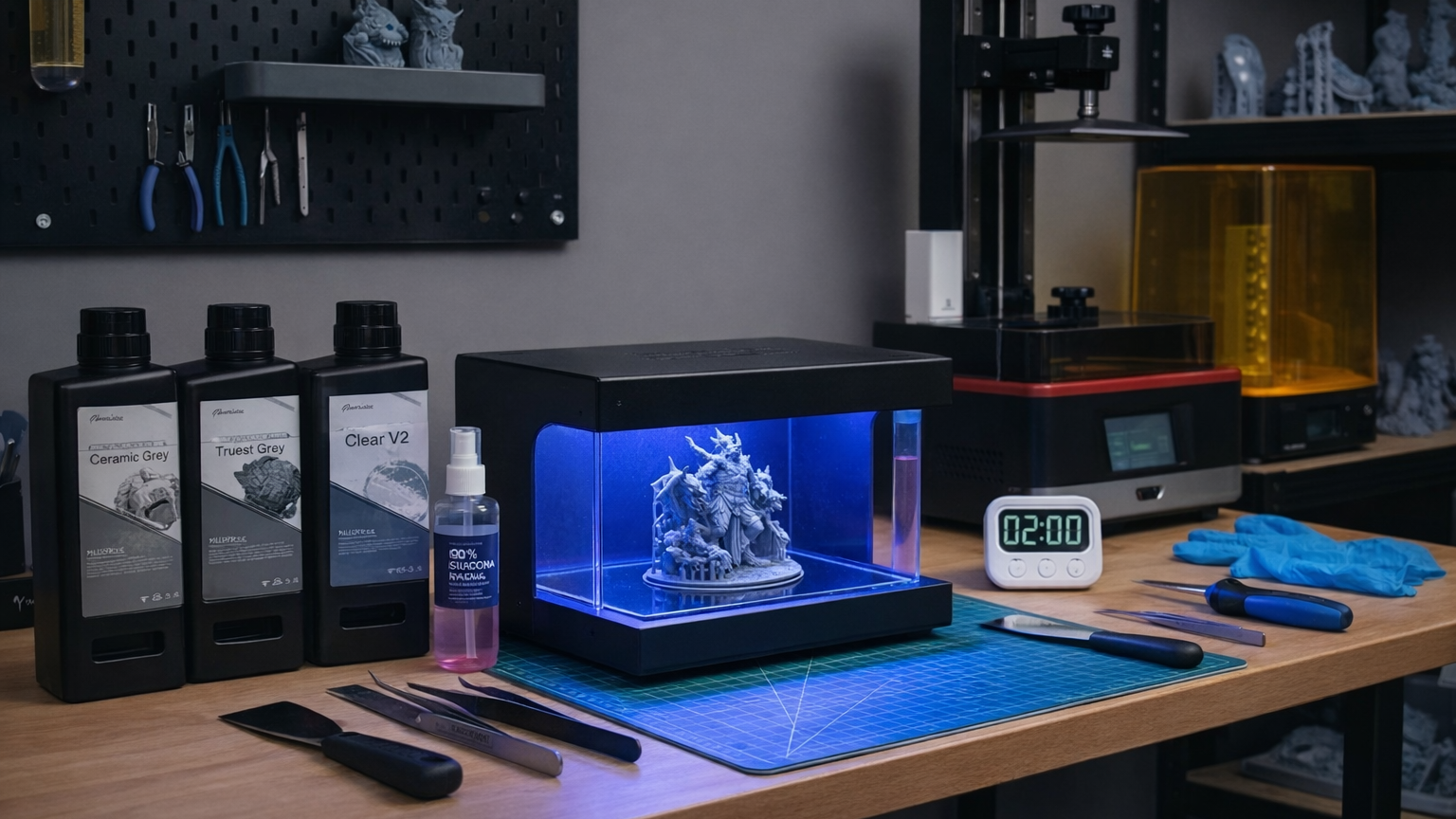
The curing time of UV resin mainly depends on the UV light intensity, resin thickness, resin formulation, and environmental conditions. Under normal conditions, surface curing usually takes 30 seconds to 2 minutes, while full curing typically takes between 2 and 10 minutes. For very thin layers, the resin can harden in as little as 10–20 seconds.
This article is going to discuss the process of curing resin 3D prints, outline the appropriate timing for each step, and what influences the timing of each step.
How Long Does Each Curing Stage Take?
The curing process of UV resin typically occurs in several stages, and each stage takes a different amount of time depending on the conditions.
Surface Cure
Time: About 10–60 seconds
What happens: The surface becomes hard to the touch
-
The resin no longer flows
-
A slight tacky feeling may remain
A surface cure helps the resin hold its shape, but it is not fully cured yet.
Partial Cure (Initial Cure)
Time: About 1–2 minutes
What happens:
-
The resin is mostly set
-
It can be lightly handled or repositioned
-
The inside may still be slightly soft
This stage is ideal for layering or embedding decorations such as glitter or dried flowers.
Full Cure
Time: About 2–10 minutes
What happens:
-
The resin is fully hardened throughout
-
No sticky residue remains
-
Final strength and clarity are achieved
Thicker layers or complex pieces may require multiple curing cycles or curing from different angles.
Post Cure (Optional)
Time: An additional 1–5 minutes
Purpose:
-
Improves hardness and durability
-
Helps prevent long-term tackiness
-
Enhances overall stability
Commonly used for jewelry or functional resin projects.
What Factors Affect the Curing Time?
The curing time is a matter of numerous technical factors. Being aware of these factors allows users to fine-tune the settings to achieve better results.
Impact of Resin Type and Color
The resin formulations are cured at varying rates. The standard modeling resins are cured within a shorter period compared to tough flexible resins or high-temperature resins, and these are the ones that have additives to influence the polymerization process.
Color also significantly impacts curing times. Light-colored or transparent resin allows UV light to infiltrate further, resulting in quicker and smoother cures. Black or deep-colored resins, like black or deep gray, absorb more of the light at the surface, so it can sometimes take many minutes to cure the entire model.
PAWW10 and PAWW20 are water-washable resins, which combine speed with simplicity of cleaning. Their formulations minimize discrepancies of trapped residue.
Model Size and Thickness
The length of time taken by the UV resin to cure is directly proportional to the physical size of the print. Thin and tiny details dry fast, and when post-curing is not meticulous, then thick variations may end up holding the uncured resin within.
Bulky solid models might require longer curing periods or gradual curing - the part should be turned over during the post-curing to give equal exposure to light. Internal stress is normally minimized, and hollow models with suitable drainage holes tend to cure more evenly.
Strength of Light Source
The UV light source is very sensitive to the intensity and wavelength. The vast majority of MSLA resins are 405nm UV light optimized. Poor sources or decreased and deteriorated UV LEDs can greatly increase the curing time or cause partial or total curing.
Specialized curing positions offer reliable production and are highly advisable as compared to makeshift solutions. Lights with lower power can be used; they take more time and must be monitored.
How Do You Know When Resin Is Fully Cured?
It takes both physical and visual examination to identify the time when a resin print is cured. It is not just enough to depend on time.
Performing the Tactile Test
A fully cured resin print must also be dry and hard to touch. It should not feel oily or tacky to the touch. Some warmth right after the curing process is normal, but when it continuously stays soft, it will be an indicator of under-curing.
When testing the new resins or new geometries, the tactile test is particularly beneficial in testing the curing time of the UV resin.
Checking for a Matte Finish
The majority of resins acquire a smooth, non-glossy surface when cured. The shiny spots tend to indicate those areas that have not been exposed to enough UV. This is usually solved by rotating the model and doing post-curing.
Signs of Over-Curing
Excessively cured resin may be brittle, yellowed, or subject to microcracks. Small details can become weak, and slim shapes are spread out a bit. In case these occur, diminish the post-curing period or brightness.
How Do You Know When Resin Is Fully Cured?
Sticky resin surfaces tend to be an indicator of an issue in the workflow, specifically how to clean resin prints, rather than just in the curing process itself.
Oxygen Inhibition-Issue
Oxygen can interfere with the polymerization process on the surface of resin prints, particularly during post-curing in open air. This occurs because oxygen molecules react with the resin’s photoinitiators more quickly than the resin monomers can, effectively starving the top layer of the chemical reaction needed to harden.
This can result in a residual tacky layer on the surface, even if the rest of the model is structurally sound. To mitigate this, you can use enclosed curing stations or water curing to create an oxygen-free environment, resulting in a significantly harder and smoother finish.
Water Curing Solutions
Water curing is where the washed print is submerged in clear water as it is exposed to UV light. Water seals off oxygen and allows the UV light to enter in a uniform manner, creating a much harder surface that is not sticky.
PAWW10 and PAWW20 water-washable resins are especially suitable for the given method. Their short rinse times: PAWW10 (3 minutes) and PAWW20 (2 minutes) mean that there is no remaining resin to get in the way of the final curing, and there is less chance of being stuck down by incomplete cleaning.
PAWW10 Water Waterproof Tough Resin
PAWW10 is a long-lasting, water-washable resin that has been compromised between performance, detail, and ease of use. It can be used perfectly to 3D print figurines, miniatures, and prototypes that need precision and toughness. In only 3 minutes, prints can be washed without using alcohol or acetone.
Key Features:
-
Clean Easy: Washing prints within 3 minutes using water alone.
-
High Durability: Strong and tough to extend the print.
-
High Detail Reproduction: Records detailed information and refined textures.
-
Low Water Absorption: Guarantees low dimensional stability and small warping.

PAWW20 Water Washable Modeling Resin
PAWW20 is made to be rapidly processed and prototyped. It can clean deeply within only 2 minutes, lessens post-curing stickiness, and can be left tough up to 1 month, and this is perfect on parts that need to be drilled, tapped, or subject to post-processing.
Key Features:
-
Fast Cleaning: Rinses will clean in 2 minutes and save time on post-processing.
-
Good Toughness: Maintains strength in functional prototypes and in mechanical applications.
-
Semi-Transparent: Can easily look into the inside structure.
-
Low Viscosity: Guarantees smooth printing plus high-quality reproduction of detail.

Essential Safety Tips and Waste Disposal Methods
Even in the case of water-washable materials, working on UV resin also demands care.
Required Protective Gear
Use the nitrile gloves at all times when handling uncured resin or freshly printed parts. Safety glasses protect eyes from accidental splashes, and correct ventilation can guard against protracted exposure to resin vapors.
Adequate Waste Resin and liquid disposal
Do not pour uncured resin or contaminated wash water down the drain. Treat waste liquids in the presence of UV light until solid, then remove them as per the local solid chemical waste disposal regulations.
Accidental skin contact Aid
Uncured resin in contact with skin should be handled carefully. Knowing how to get resin off hands effectively is crucial; wash with soap and water as soon as possible. In the case of irritation, consult a doctor and avoid working with resin until the problem is eliminated.
FAQ
Can I Use a UV Nail Lamp for 3D Prints?
A UV nail lamp may be used on small-sized resin prints, but this is not an optimal choice. The lighting of nail lamps can also be lopsided and less powerful than specific curing stations. This may prolong the curing period and produce inconsistent outcomes, particularly in thicker MSLA prints.
Does Curing Affect the Dimensions of the Print?
Yes, curing may lead to slight dimensional variation. When resin is allowed to cure, its shrinkage might be minimal. Dimensional variability in most applications is maintained within reasonable tolerances through proper exposure conditions and regulated post-curing.
Why Did My Resin Print Crack After a Few Days?
Internal stress through uneven or lack of adequate curing normally results in delayed cracking. The resin, which was not dried but is contained in thick or hollow sections, can keep on getting hard with the course of time. This risk is greatly minimised by thorough washing, proper drainage, and complete post-curing.
Conclusion
How Long Does UV Resin Take to Cure? The solution lies in the exposure to printing and post-curing. MSLA printing requires seconds per layer to cure in layers and several minutes to cure completely in good UV light. The types of resin, its color, the geometry of the model, and the intensity of light are all important.
Knowledge of every curing stage and appropriately formulated materials like PAWW10 and PAWW20 water-washable resin enables the user to produce constant and quality outcomes. The understanding of the curing time of UV resin enhances surface finish, strength, and long-term stability and safety of resin 3D printing projects.
Share:
Does Hot Water Soften 3D Print Resin?
FDM vs. UV Resin Weight: Key Differences and Which to Choose