

If you are designing products, testing an idea, or developing parts, understanding what rapid prototyping is can totally transform how quickly you can get a prototype to production.
Rapid prototyping enables designers and engineers to develop physical models in a short time, test them earlier, and refine designs without lengthy delays in manufacturing. SLA 3D printing is the fastest, finest, and most professional technique in all the possible options.
What Is Rapid Prototyping?
Rapid prototyping is a specialized approach within prototyping that focuses on producing physical prototypes quickly, typically through digital design workflows and fast manufacturing technologies such as 3D printing.
By emphasizing speed and iteration, rapid prototyping enables designers and engineers to test and revise designs in shorter development cycles.
Rapid Prototyping vs Prototyping
Prototyping refers to the general process of creating preliminary models or samples to evaluate product concepts, designs, or functionality during development. It encompasses a wide range of approaches, from simple sketches and digital mockups to physical models made through manual or mechanical methods. The primary goal of prototyping is to test ideas, identify potential issues, and refine designs before final production.
The following table helps distinguish between the two:
|
Comparison Aspect |
Prototyping |
Rapid Prototyping |
|
Concept Scope |
Broad, general concept |
Subset of prototyping |
|
Production Method |
Manual, digital, or conventional manufacturing |
Digital design combined with rapid manufacturing |
|
Speed |
Varies depending on method |
Very fast |
|
CAD Dependency |
Not always required |
Required |
|
Physical Prototype Required |
Not necessarily |
Usually involves physical models |
|
Primary Purpose |
Concept validation and design exploration |
Rapid testing and fast iteration |
|
Cost |
Varies widely |
Relatively controlled with low initial investment |
3 Key Advantages of Rapid Prototyping
Rapid prototyping does not only involve speed. It basically enhances the entire process of product development.
Faster Turnaround Times
CAD files can be transformed into physical parts within a day, and teams are able to test their ideas practically right after making them.
Lower Development Costs
Rapid prototyping reduces upfront investment and enables repetition of design by removing molds and tooling, and reducing the cost of prototyping.
Free to Test and Improve
Designers are able to test form, fit, and function early, make changes to dimensions, and optimize functionality before mass production is made possible.
Types of Rapid Prototyping Technologies
Rapid prototyping technologies differ in terms of cost, precision, surface quality, and production speed, with no single method excelling in every aspect. The following sections outline the most common technologies and explain where each one is best applied.
FDM 3D Printing
FDM involves the use of molten thermoplastic filament and is known for its low cost and availability. It is good with simple shape validation, though when comparing resin vs filament, FDM is generally not as capable of producing fine surface details.
SLS 3D Printing
SLS involves the fusion of powdered materials through lasers to produce durable functional components without support structures. It is good to use in industries, but it is both expensive to equip and operate.
Resin 3D Printing
By using a resin 3D printer, this method provides the best detail and finish in terms of surface and is suited for precision prototypes.
-
Laser SLA
In the traditional SLA, a laser is used to cure the resin point by point. It is highly accurate and can be slower with bigger builds.
-
LCD mSLA
LCD mSLA cures a complete layer during an LCD mask. The method consists of using the same SLA principle of photopolymerization but with significantly higher print rates, which is suitable in a fast-prototyping process.
FDM vs. SLS vs. Resin 3D Printing Comparison Table
|
Feature |
FDM |
SLS |
Resin (SLA/mSLA) |
|
Surface Finish |
Rough |
Grainy |
Very smooth |
|
Accuracy |
Moderate |
High |
Very high |
|
Strength |
Moderate |
High |
Resin-dependent |
|
Speed |
Moderate |
Fast for batches |
Very fast |
|
Cost |
Low |
High |
Mid-range |
|
Best Use |
Concept models |
Functional parts |
Detailed prototypes |
Each rapid prototyping technology offers distinct advantages, and no single method is optimal for every application. Selection should be based on the specific balance of detail, strength, speed, and cost required.
In applications where high accuracy and fine surface quality are prioritized, resin-based technologies such as SLA and mSLA are commonly used for rapid prototyping.
Why Is SLA 3D Printing Ideal for Rapid Prototyping?
SLA is one of the most widely used resin 3D printing technologies. It employs a laser to scan point by point and cure liquid resin along predefined paths, enabling high accuracy and fine surface detail. These features make SLA particularly well suited for rapid prototyping.
From medical and dental fields to consumer electronics and jewelry design, SLA is widely adopted across multiple industries. The following sections outline the key reasons why this technology is so commonly used.
Accurate Prototypes for Shape and Fit Evaluation
In product development, dimensional accuracy directly affects the reliability of prototype evaluation. SLA 3D printing produces parts with consistent dimensions and fine feature resolution through its laser-based curing process. This allows designers to assess geometry, tolerances, and assembly relationships with a high level of precision.
As a result, SLA prototypes can be used to identify fit or alignment issues earlier in the development process, supporting more informed design adjustments.
Material Options Suitable for Functional Testing
SLA 3D printing supports a wide range of resin materials with different mechanical and visual properties. Designers can select resins based on specific requirements such as rigidity, flexibility, transparency, or chemical resistance.
Using application-appropriate materials allows prototypes to be evaluated under conditions that more closely resemble real-world use, providing practical input for functional testing and design refinement.
Surface Quality for Visual and Form Assessment
SLA technology produces parts with smooth surfaces and fine details due to its high printing resolution. Compared with many other additive manufacturing methods, visible layer lines are less pronounced.
This surface quality allows designers to focus on form, curvature, and overall appearance during design reviews or presentations, without surface artifacts interfering with visual evaluation.
Short Turnaround to Support Iterative Development
SLA 3D printing does not require tooling and can produce customized parts within relatively short timeframes. This enables faster transitions from digital models to physical prototypes.
Shorter production cycles support iterative testing, allowing design changes to be implemented and reviewed without extended delays in the development process.
4 Steps of Rapid Prototyping with SLA
Rapid prototyping can be adopted more easily with an understanding of the workflow.
Step 1: CAD Design
Design your part using CAD software, ensuring dimensions and tolerances match real-world requirements.
Step 2: Slicing
The model is sectioned into layers in software that automatically creates supports and optimizes the exposure settings.
Step 3: Printing
The SLA printer cures the resin as layers, creating a very precise physical form.
Step 4: Post-Processing
The part is then washed and cured by UV light after having been printed and slightly finished to achieve final strength and appearance.
What Can You Build with Rapid Prototyping?
Rapid prototyping is useful in a wide variety of applications in the real world, both in early testing and in determining how practical the machine is.
Functional Mechanical Parts
SLA printers with consistent accuracy and automated setups are much appreciated when it is time to do rapid prototyping with functional parts like brackets, gears, housings, or precision fixtures.
Industrial Components and Housings
SLA prototypes are widely used to test housings, fixtures, and protective casings before moving to injection molding.
Assembly and Fit Testing
The ability to test high-dimensional accuracy enables teams to test how various parts come together to prevent costly redesigns in the future.
An Efficient Alternative Solution
To meet these demands in a studio or office setting, you need equipment that balances precision with ease of use. The following printers provide a streamlined workflow, ensuring that high-quality prototyping is accessible and consistent:
The Reflex RS 3D Printer Ideal for designers seeking reliability, this printer combines a C5-grade Z-axis and 8K LCD for micron-level precision. It simplifies the process with automated resin refilling, heating, and auto-leveling, delivering smooth, functional parts with a minimal learning curve.

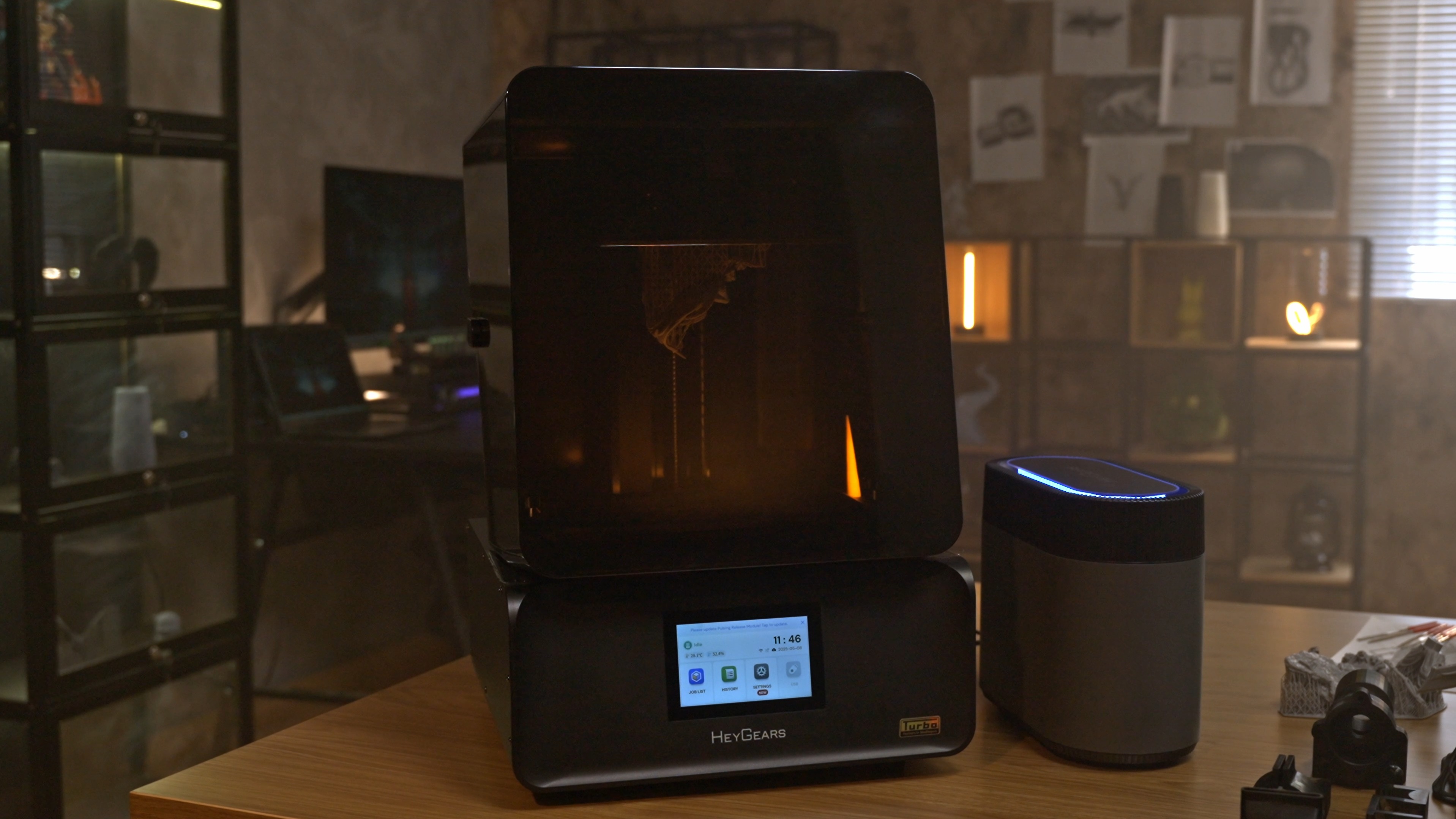
The Reflex RS Turbo 3D Printer Built for high throughput, this model accelerates iterations by up to 33% using the Dynamic Motion Algorithm 3.0. Featuring an optimized Amber Screen, it ensures detail clarity even at high speeds, making it perfect for time-sensitive development cycles.

FAQ
Is the Cost of SLA Rapid Prototyping Worth It for Small Developers?
Yes. Desktop SLA systems save on outsourcing costs and enable small workgroups to provide rapid iterations without substantial initial investments.
How Do Engineering-Grade Resins Compare to Injection-Molded Plastics?
Although they are not exactly the same, modern resins share the same characteristic strength, stiffness, and heat resistance to be used in functional testing.
What Software Is Used for Rapid Prototyping?
The majority of the workflows use CAD programs for design and specialized slicers to create printable files.
Should You Choose SLA or SLS for Low-Volume Functional Parts?
SLA is suited to be used in detailed and precise parts, whereas SLS is suited to be used with end-use and high-strength components.
Is Resin 3D Printing Safe to Do at Home or in a Small Studio?
With proper ventilation, gloves, and simple safety precautions, the SLA printing can be safely done at home and in a small studio.
Conclusion
Understanding what rapid prototyping is comes down to speed, accuracy, and fast iteration. SLA 3D printing provides all three, which is why it is best to use it in the process of functional testing and design development. The Reflex RS 3D Printer is a good option with beginners and small teams due to its automation and consistent accuracy, while the Reflex RS Turbo 3D Printer is more oriented to the fast workflow and higher output.
Both show how SLA technology can streamline rapid prototyping from concept to finished part. The two demonstrate how the concept of SLA technology enables quick prototyping of the finished part.
共有:
What Is Resin Made of? Main Components and Resin Types
How to Get Resin off Hands? Effective Methods You Need to Know