

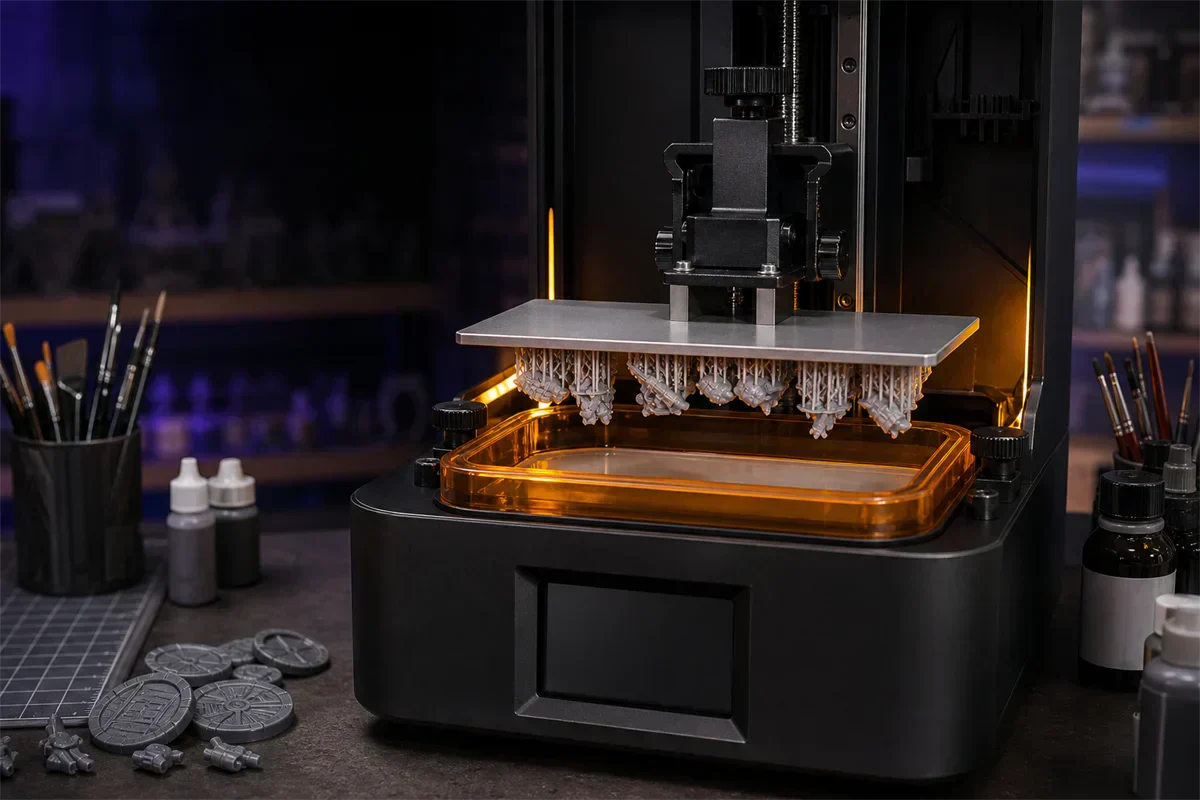
For Warhammer-scale miniatures, the best resin printer is not simply the one with the biggest K number. It is the one that delivers sharp detail, reliable batch printing, and a workflow that does not fight you every step of the way.
Warhammer miniatures are one of the toughest tests for any resin 3D printer.
A standard infantry model is usually around 28mm to 32mm tall. That means the face, armor trim, purity seals, weapon teeth, shoulder icons, and tiny surface textures may only be a few millimeters wide. For Warhammer hobbyists, "good enough" is rarely good enough. If the details look soft, if the layer lines are obvious, or if half the squad fails during printing, the printer quickly becomes more frustrating than fun.
So when choosing a resin 3D printer for Warhammer-style miniatures, do not only look at marketing terms like 8K, 12K, or 14K. What really matters is how those specs translate into clean details, reliable batches, and a smoother hobby workflow.
1. Detail: Look Beyond "8K" and Check XY Resolution
For miniature printing, XY resolution is one of the most important specs to understand.
Many printers advertise screen resolution, but screen resolution alone does not tell the full story. A larger screen with more pixels may still have a bigger pixel size than a smaller screen with fewer pixels. For Warhammer-scale miniatures, the key number is pixel size, usually measured in microns.
For crisp tabletop miniatures, a good target range is around 20 microns to 35 microns XY resolution.
At this level, a resin printer can better reproduce small details such as chainsword teeth, armor emblems, helmet lenses, face masks, cloth texture, purity seals, rivets, cables, and weapon edges.
If the XY pixel size is too large, these details can become soft or blurred. The model may still look fine from across the table, but once primed, painted, and drybrushed, weak detail becomes much easier to notice.
2. Light Uniformity: The Full Build Plate Should Print Consistently
Warhammer players rarely print one model at a time. More often, they are printing a full squad, vehicle parts, bases, weapons, heads, shoulder pads, or terrain accessories.
That makes light uniformity extremely important.
On cheaper or poorly designed printers, models near the center of the build plate may print sharply, while models near the edges look softer or less consistent. For miniature printing, this is a real problem. A full build plate should not feel like a lottery.
Good light uniformity helps ensure that every model on the plate gets consistent exposure, whether it is in the center, corner, or edge of the build area. If you want to print full squads efficiently, this matters just as much as raw resolution.
3. Speed: Can It Handle Batch Printing?
Warhammer is a model-heavy hobby. Even a small army can require dozens of infantry, weapon options, bases, characters, accessories, and terrain pieces.
That is why print speed matters.
The important question is not just "How fast can the printer move?" but "Can it print quickly without increasing failure risk?" A good miniature printer should support fast layer exposure when paired with suitable resin, while also reducing peel force during lifting.
This is where release film and motion design become important. Films such as ACF-style release film can reduce separation resistance compared with traditional FEP in some setups, allowing faster lift speeds and helping reduce the risk of broken supports.
For Warhammer-style batch printing, faster printing is not about impatience. It is about making army building practical.
4. Reliability: Failed Prints Are the Real Cost
Resin is not cheap. Time is not cheap. Cleaning up failed prints is definitely not fun.
For beginners, one of the biggest pain points is leveling. A poorly leveled build plate can cause failed first layers, partial adhesion, warped bases, or models falling into the vat. For miniature printing, where many small parts and supports are packed onto a plate, leveling problems can quickly ruin an entire batch.
That is why features such as auto-leveling or a stable, easy-to-repeat leveling system are worth paying attention to.
Stable adhesion helps prevent failed starts, warped bases, and partial builds.
Lower release stress can help thin weapons, banners, and accessories stay attached.
Batch printing depends on similar exposure behavior from center to edge.
Beginner-friendly calibration reduces the chance of losing an entire squad.
5. Slicer Support: Supports Decide Success or Failure
Warhammer-style models often include capes, weapons, spikes, horns, helmets, backpacks, banners, and sharp overhangs. These shapes can be tricky to support.
That makes slicer compatibility very important.
A good resin printer should work smoothly with mainstream slicers such as Lychee Slicer or CHITUBOX. These tools give users more control over supports, hollowing, drainage holes, exposure settings, orientation, and batch layout.
Supports are where many miniature prints succeed or fail. Too few supports, and parts fail. Too many supports, and you damage fine details during removal. A printer that fits well into a mature slicer workflow will make the learning curve much easier.
6. Workflow: Printing Is Only Half the Hobby
A resin print is not finished when the build plate comes out of the printer. You still need to wash, dry, cure, remove supports, inspect details, and prepare the model for priming.
For miniature hobbyists, a complete workflow matters.
A printer that works well with matched washing and curing equipment can make the whole process cleaner and more repeatable. This is especially valuable when printing multiple squads or batches of small parts.
The smoother the workflow, the more time you can spend painting, kitbashing, and playing instead of troubleshooting resin mess.
Recommended Pick: HeyGears RS Turbo
For Warhammer miniature printing, the ideal resin printer needs to balance four things: fine detail, speed, reliability, and workflow.
That is why HeyGears RS Turbo is a strong choice for hobbyists who want a more complete printing experience instead of just another spec sheet. It is designed for high-quality resin printing, supports a more streamlined production workflow, and fits well with the needs of miniature users who care about both detail and success rate.
For Warhammer-style use cases, RS Turbo is especially compelling because it addresses the real pain points: fine detail reproduction for 28mm to 32mm miniatures, more consistent batch printing, faster production potential for squads and accessories, and a cleaner workflow when paired with compatible washing and curing equipment.
If your goal is to print one display model, many resin printers can do the job. But if your goal is to build armies, print full squads, test poses, create custom bits, and maintain a steady hobby workflow, RS Turbo is a much better fit.
Final Thoughts
Choosing a resin 3D printer for Warhammer miniatures is not about chasing the biggest "K" number on the box.
Look for the specs and features that actually affect miniature quality: XY resolution, light uniformity, print speed, release performance, leveling, slicer compatibility, and post-processing workflow.
For tabletop hobbyists, the best printer is the one that helps you get crisp details, repeatable batches, and fewer failed prints. That is where a complete system like HeyGears RS Turbo can make a real difference.
Small models expose every weakness in a printer. Choose the machine that treats miniature detail seriously.
This article is not affiliated with or endorsed by Games Workshop.
Share:
High Detail for Under $800: Is the HeyGears RS Turbo the Ultimate Miniature Printer?
One Machine, Endless Revenue Streams: Why the HeyGears G1X Is Built for Small Businesses