

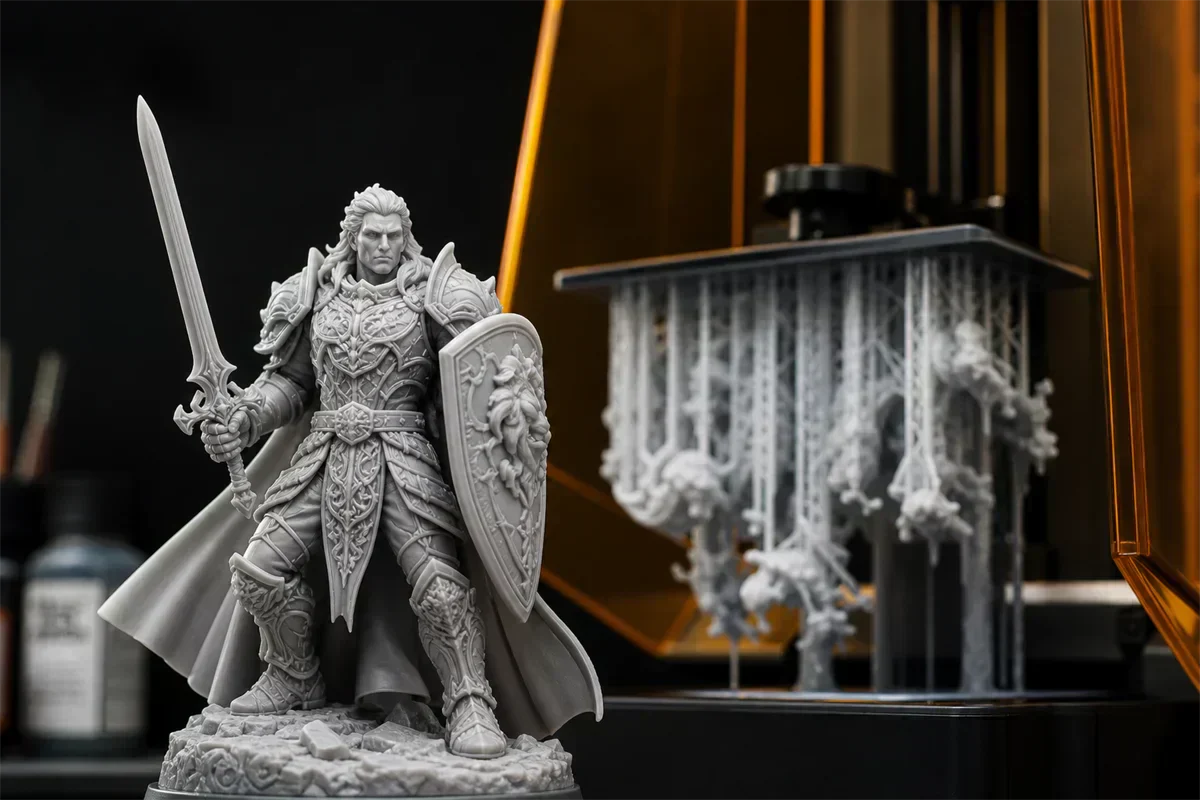
01. The Miniature Maker's Dilemma
For miniature painters, tabletop gamers, and independent model makers, finding the right 3D printer can feel like a hobby all its own.
What we want from a machine sounds simple. In practice, the bar is incredibly high:
Detail is everything. At the standard 28mm or 32mm scale, a soft facial expression, a muddy crest, or a missing fold in a cloak can make an otherwise great sculpt feel lifeless.
Time matters. When inspiration hits—or game night is coming up—you want to slice the file and start printing. Long preorders, shipping delays, and endless calibration quickly kill the momentum.
Budget is real. Industrial resin printers can produce stunning results, but a price tag in the thousands puts them out of reach for most hobbyists and small studios.
After comparing the major consumer resin printers on the market, I turned my attention to the HeyGears RS Turbo. HeyGears has years of experience in digital dentistry and industrial additive manufacturing, so the company's move into a more accessible desktop system immediately caught my interest. After spending real time with the printer—and running several kilograms of resin through it—here is where I landed.
02. Three Reasons I Chose the HeyGears RS Turbo
1. An Industrial Pedigree at a Sub-$800 Price
For a long time, the HeyGears name was associated with professional dental workflows, industrial applications, and professional-level pricing. The engineering reputation was there, but the cost kept most individual makers at a distance.
The RS Turbo changes that equation. At under $800, it lands in the same general price range as a premium consumer machine while bringing HeyGears' experience in optics, motion systems, and software tuning to the desktop. For a miniature-focused workflow, that value proposition is hard to ignore.
2. The Crisp, Razor-Edged Detail Miniatures Need
Soft edges and visible layer lines are the fastest way to ruin a detailed miniature. This is where the RS Turbo made its strongest first impression.
From infantry-sized characters to large monsters with open wings and intricate accessories, the edges came out remarkably clean. Fine hair strands, recessed weapon details, armor trim, and tiny surface textures that looked good on screen were still readable in the finished print. The result has the sharp, refined look I want from a miniature before primer ever touches it.


3. In Stock and Ready to Work
Availability does not sound exciting until a project is waiting on a printer. Too many promising machines spend months in preorder, move through uncertain production schedules, or arrive without a dependable supply of resin and replacement parts.
The RS Turbo offers something less glamorous but genuinely valuable: predictability. A stable supply chain means less time waiting and more time making. For a small studio with deadlines—or a hobbyist who simply wants to get started—that confidence matters. Ongoing material availability and regular software updates also make the system feel like a long-term tool instead of a one-off purchase.
03. From Unboxing to Finished Print
A Hardware and Software Ecosystem That Stays Out of the Way
A good printer should not make you earn every successful build through hours of trial and error. The RS Turbo feels polished out of the box, and the overall setup is approachable even if you do not enjoy tinkering with hardware.
The software is just as important. Exposure settings, lift behavior, and material profiles are deeply integrated into the slicing workflow. Instead of spending days running exposure tests and chasing community presets, I could focus on orientation, supports, and the model itself. Fewer failed prints means less wasted resin—and much less wasted time.
Fine Supports Without Sacrificing Reliability
Miniatures are rarely easy prints. Flowing capes, narrow weapons, outstretched fingers, and aggressive poses create islands and overhangs everywhere.
In my testing, the RS Turbo handled release forces smoothly enough for fine supports to remain dependable throughout the print. Those supports held delicate features securely, yet they were still manageable during cleanup. That balance matters: a support must survive the build without leaving the finished model covered in heavy scars. A higher success rate is not just satisfying—it is a real productivity gain.


04. Who Is the RS Turbo For?
After putting the machine through its paces, I do not see the HeyGears RS Turbo as a generic do-everything printer. It is a focused tool with a very clear strength: producing small, demanding parts with minimal fuss.
It makes the most sense if these priorities sound familiar:
- Detail comes first. Your main projects are tabletop miniatures, display figures, fine art pieces, or high-resolution prototypes.
- You value your time. You want a machine that is available now, supported by a stable ecosystem, and ready to become part of your workflow.
- Your budget is around $800. You want premium print quality and a more polished end-to-end experience without stepping into industrial-machine pricing.
Bottom line: If high-detail miniatures are your priority, the sub-$800 HeyGears RS Turbo deserves a place near the top of your shortlist. It combines crisp results, a streamlined workflow, and the confidence of a mature hardware-and-software ecosystem in a package that remains accessible to serious hobbyists and small studios.
共有:
Meet HeyGears G1X: The World’s 1st Desktop 3-in-1 Full-Color 3D & UV Printer
Warhammer Miniatures: How to Choose the Best Resin 3D Printer for 28mm Models