

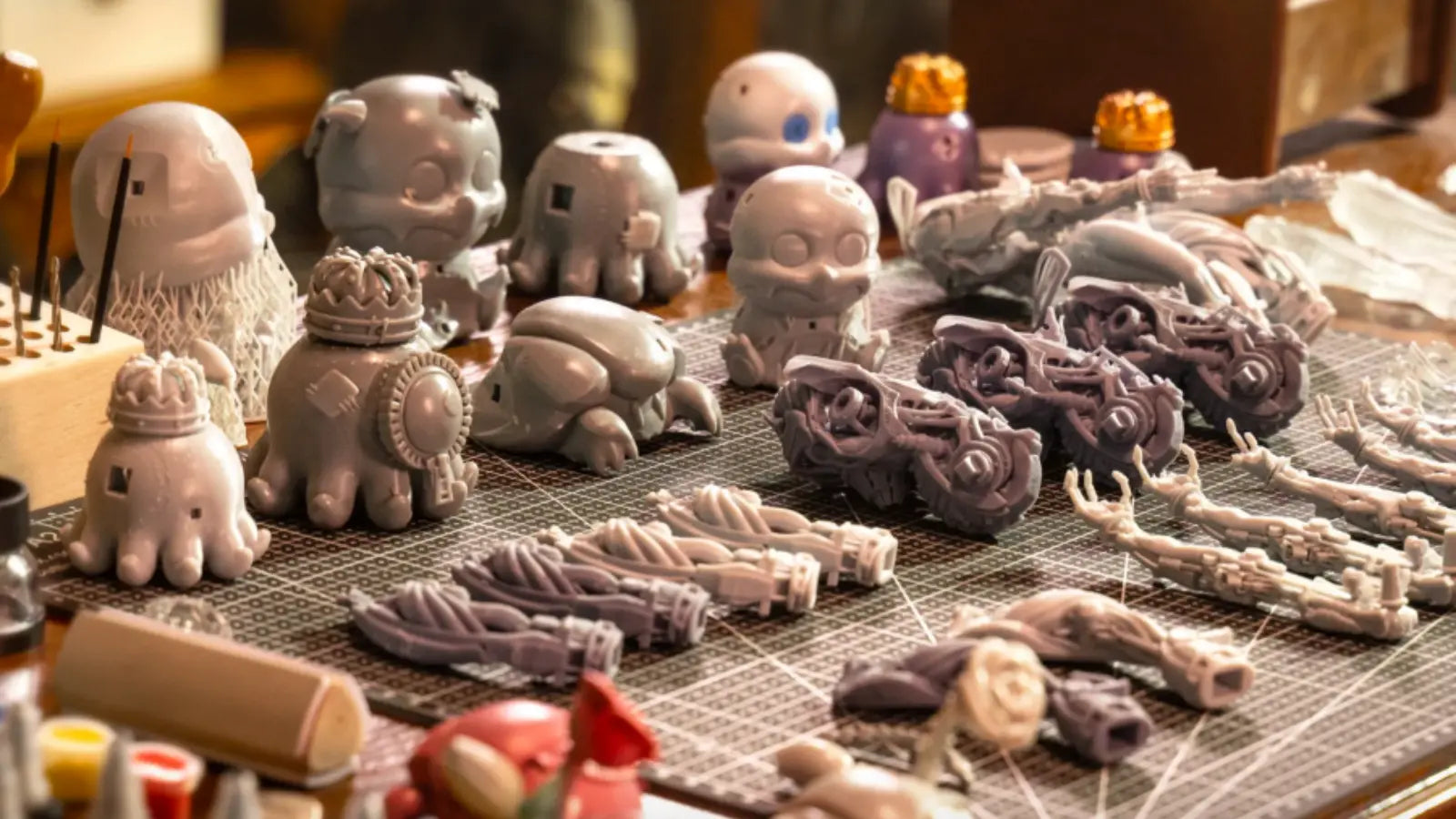
Toys in 3D have increased rapidly. They are not mere figurines any longer; they incorporate creativity, engineering, and customization. In 2026, 3D printing is used by hobbyists, designers, and small factories to create toys that are interactive, educative and attractive to the eye. The technology of printing new resins provides high detail, high quality of surface, and accuracy of movement. This list contains the 15 most creative 3D printed toys of 2026. It also recommends a step-by-step resin printing process and professional safety and quality tips.
Top 15 3D Printed Toys in 2026
Here are the top 15 standout toys that showcase innovation, intricate design, and playability.
Articulated and Flexi Toys
Top choices of 3D printed toys include articulated toys: the motion and flexible parts provide them with interesting movement.
Toy 1: Flexi Dragon
The Flexi Dragon is an example of print-in-place articulation. It contains interconnected joints that bend and twist together without post assembly. The toy has an alternative use as a display and stress-relieving toy.
Toy 2: Flexi Octopus
The Flexi Octopus has tentacles that move separately in soft, flowing waves. Its natural geometry demonstrates the resolution achievable through resin printing, particularly on curved surfaces and through joint clearances. Tentacle length, suction-cup texture, or facial expression are frequently customized by the designer.
Toy 3: Poseable Robot Figure
Poseable robot figures have a modular articulated design. These toys also tend to be removable in parts, such as limbs or accessories. Resin printing provides crisp edges, mechanical detailing, and smooth rotation of joints. For a high-end finish, techniques for achieving smooth surfaces and intricate details can further highlight mechanical lines and panel details.
Vehicles and Launchers
Cars and launchers have motion and mechanics, which bring fun and learning.
Toy 4: Rubber-Band Powered Car
The toy is a simple elastic energy conversion routine that transforms the tension stored into forward movement. High-dimensional accuracy can be resin printed in the chassis and gears up to the axle supports. These toys demonstrate fundamental mechanical concepts, and at the same time, they are engaging and entertaining.
Toy 5: Pull-Back Buggy
Pull-back buggies have spring-driven or gear-driven pull-back systems. Resin printing is best used in the housing of tight-tolerance gear systems. The designers tend to approach designs with wheel tread patterns and suspension appearance to increase the realism.
Toy 6: Mini Catapult Launcher
Desk toys and learning equipment include mini catapult launchers. The toy will usually comprise a base, an arm, and a pivot pin, which can be printed with resin to strengthen and turn smoothly. This design represents lever concepts and projectile motion in a real physical manner.
Board Games and Puzzles
Board games and puzzles make the most out of the precision and customization of 3D printing.
Toy 7: Rolling Ball Maze Cube
A rolling ball maze cube is a challenge that asks the users to roll a ball in internal channels. Resin printing has the benefit of creating enclosed structures and clear or semi-clear components, allowing players to observe internal routes.
Toy 8: Combination Puzzle Box
The fixing of slide panels and lock mechanisms is highly accurate in combination puzzle boxes. The precision required of resin printers is to provide a smooth motion and have no unnecessary friction. These toys are used as gift boxes or brain teasers.
Toy 9: Secret-Compartment Puzzle Cylinder
The cylindrical puzzle contains lockable compartments that open with certain rotations or rotation orders. It's small, several-layered geometry shows how 3D printed toys can combine aesthetics with mechanical logic.
Dolls and Miniatures
Miniatures require precision, smoothness, and proportions. The most appropriate way to do that is resin printing.
Toy 10: Printable BJD Mini Doll
The most complex 3D printed toys are ball-joint dolls (BJD). The balance between friction and the freedom of movement is needed by each joint. Resin printing creates smooth skin and the correct shape of the joints, hence the doll looks good.
Toy 11: Miniature Pet Figure
The miniature pets are frequently printed either as a collection or as custom gifts. Printing of high-resolution can reproduce fur texture, the features of faces, and posture, which are hard to achieve by filament printing.
Toy 12: Mini Diorama Scene Box
A diorama box is a box that displays a few small elements. Resin printing is also good on small props, architectural components, and figures, and allows you to recount a story with a fixed picture.
STEM and Mechanisms
Toys based on STEM combine learning and play. Mechanical movement can be easily observed and touched.
Toy 13: Cam-and-Follower Walking Toy
This toy demonstrates the way a cam delivers a walking movement. They use resin printing to ensure the cam is smooth, and the follower travels consistently, thus the activity can be easily seen.
Toy 14: Planetary Gear Fidget Spinner
Planetary gear fidgets are touch toys that are more complicated mechanically. The Resin printing allows you to print various mesh gears, which operate in a smooth and pleasing manner.
Toy 15: Geneva Drive Motion Toy
Geneva drive toy exhibits intermittent movement that you tend to observe in engineering. It is informative and striking. Resin printing produces sharp teeth and accurate indexing.
Which 3D Printer and Materials Do You Need for 3D Printing Toys?
Choosing the right 3D printer and materials is essential to creating high-quality, durable, and detailed toys.
Picking the Right 3D Printer for Toy Making
The selection of demonstrates quality, safe, and durable 3D-printed toys, being critical to the choice of a suitable printer. Resin printers perform better where smooth surfaces are required, in addition to the complex features.
The HeyGears Reflex 3D Printer stands out as a high-end option that balances precision and ease of use. It offers excellent resolution and stabilized exposure control, resulting in clean surface finishes and sharp details. This makes it especially suitable for creating toys with moving parts and fine features, such as ball-jointed dolls (BJDs) and detailed miniatures, where dimensional accuracy and surface quality are paramount.

For those aiming at higher production volumes or professional-scale manufacturing, the HeyGears Reflex2 3D Printer offers enhanced throughput without sacrificing print quality. Its robust build and streamlined workflow support continuous operation, helping you meet larger orders while maintaining the fine detail and structural integrity required for premium toy products.

Key Materials for 3D Printed Toys
The resin that you use significantly shapes toy longevity and overall look. Fine detail with standard resin is added, although tough or engineering resin is added to give impact resistance. In the case of the moving parts of the toys, a resin is chosen that will be flexible and strong to ensure that the joints are not lost.
Software to Use with 3D Printed Toys
Professional slicing and modelling software promises appropriate exposure, support location, and patient dimensionality. Mechanical toys can be sculpted with CAD software, and organic shapes (dolls, animals, etc.) can be sculpted with sculpting software.
Step-by-Step Guide to Resin 3D Printing Toys
Using the HeyGears Reflex 3D Printer as an example, this step-by-step guide will walk you through the process of creating detailed resin 3D printed toys, such as BJD dolls.
Step 1: Set Up Your Resin 3D Printing Project
Establish the purpose, magnitude, and mechanical requirements of the toy. Ensure that the wall thickness, clearance of joints, and structural parts are aligned with resin properties. Consider who is going to use it and how it will be used; versions of a doll will not have the same structural requirements as a toy that will be played with many times. The planning decreases later in the workflow print failures and the redesign of the plan that happened at a later point.
Step 2: Import the Toy Model and Option Orientation
Take the model to slicing software and place it in a position where the layer lines are minimal to view on significant surfaces. Adequate orientation also reduces contact of support on aesthetic surfaces. Resin drainage is another issue that should be considered since trapped resin may ruin internal features and the finish of the surface. The virtual experimentation of the various orientations enhances the success of prints and the final look.
Step 3: Add Supports and Check Important Details
Add remedies to strengthen an overhang, a thin section, and a joint. Check small details, make sure supports do not come into contact with working surfaces. Smaller and lighter supports should be used on any delicate parts, and heavier ones on parts that carry weight to provide stability and convenience during removability. The articulation, surface quality, and dimensional accuracy are maintained by a comprehensive inspection.
Step 4: Duplicate Parts and Arrange the Layout
Have replicas print effectively on the printing platform in batches. Varying marks provide a balance of the flow of resin and curing. The plate should not be crowded to produce uneven exposure and print inconsistencies. Moreover, strategic layout also eases up onpost-processings and minimal probability of collisions of parts with the printing process.
Step 5: Slit the File and Begin the Print
Modify resin type and model complexity exposure setting. Once sliced, begin printing and keep an eye on the early layers to make sure they are adhesive. Pay attention to the bottom-layer exposure, which defines the build-plate sticking and stability in general. The early observation will help you make the necessary intervention in case of adhesion or alignment issues.
Step 6: Post-Processing Resin Prints: Wash, Cure, and Finish
After printing, wash and clean 3D resin prints thoroughly to remove uncured resin before curing, which helps preserve detail and improves final strength. Surface finishing or light sanding can be provided to achieve high-end results. Curing Times: Since brittle surfaces and under-curing might occur when matching their manufacture to the resin manufacturer’s suggestions. The last check is to ensure that moving parts operate without any problems and that no detail is missed.
Tips for Creating High-Quality 3D Printed Toy
The following are some tips to create a high-quality 3D printed Toy
Ventilation and PPE First
Use the resin printers in well-ventilated places. Wear eye protection, a mask, and gloves to minimize the risk of exposure during handling and after processing.
Consider Uncured Resin as Unsafe
Do not touch uncured resin on the skin or in finished toys. Washing and curing should be done carefully. Always handle uncured resin with caution, as it can cause skin irritation or allergic reactions.
Dispose Responsibly
Keep waste resin, contaminated paper towels, and cleaning solvents out of the environment by disposing of them in accordance with local standards to reduce negative effecon to the environment.
FAQ
Are 3D Printed Toys Durable?
Durability depends onthe selection of material, the thickness of the design, and the after-processing quality as well. Modern Resin-printed toys may be surprisingly sturdy when satisfactorily cured, particularlforto display or light play. When subjected to rough handling, tougher resins should be,s ed and reinforced as needed to be done to avcrackingkage or joint failure with time.
What’s the Difference Between FDM and Resin 3D Printed Toys?
FDM toys tend to be more robust and harder to impact, but do not have the detail in the finer surface. The resin printers are more precise, smooth, and geometrically complex, which is why they are useful in working with miniatures and articulated designs. FDM suits larger, rugged toys.
Can I 3D Print Toys with Moving Parts and Intricate Details?
Yes. Resin printers can handle complicated mechanisms and moving parts. They include print-in-place, gears, and articulated joints. This is dependent on the precise tolerances, correct orientation, and specific placement of the support to facilitate a functional movement. For print-in-place mechanisms, gears, and tight tolerances, choosing the right resin 3d printer can make the difference between stiff joints and smooth motion.
Conclusion
The future of 3D printed toys is creativity, customization, and accuracy in manufacturing. Due to the improvement of resin printing technology, designers have an opportunity to create toys that would compete with traditional manufacturing in quality but still have the flexibility of digital design. Any person can become a toy producer and make creative ideas into a high-quality toy to play, learn, or look at with the right printer, materials, and workflow.
共有:
What Causes Stringiness on 3D Prints?
How to Clean Resin Prints with Alcohol and Water